03
MAPLE & MINT
KORTRIJKNew, unobtrusive neighbors in the historic urban landscape
The proposed project integrates seamlessly into this distinctive urban landscape, in terms of scale, architectural design, choice of materials, and intended use. The city hall, located at 13/13A on the square, will regain its former splendor thanks to the demolition of the (lower-quality) annexes. The former school outbuildings will also be demolished.
An addition will be built onto the existing mansion—whose white stucco facade will be preserved—to accommodate ancillary functions and vertical circulation. In this way, the ceremonial floor and the stairwell can be preserved from any major alterations. The main house and the extension are being converted into four residential units, an office, and a multifunctional space, collectively named “Maple.”
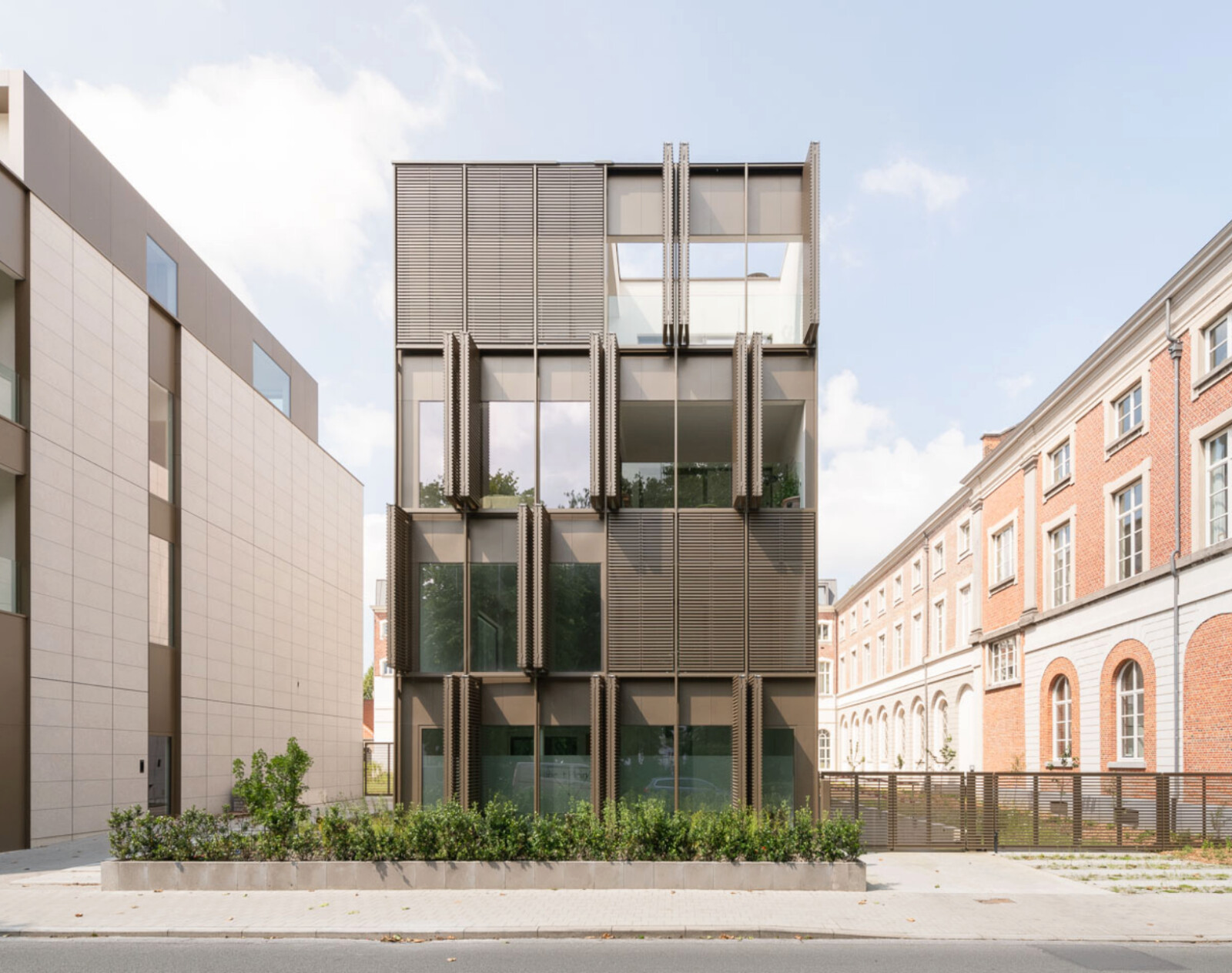
The architecture of the two new, slender yet substantial buildings on the Place de Courtrai is understated and unadorned. It serves as a neutral backdrop to the historic surroundings and incorporates certain elements from them, transposed into the present.
A varied, vertical design has been developed, with dimensions that harmonize with the existing context. The use of “shutters” on the slender, vertically oriented facades references the shutters found on many historic buildings in the region (in the broadest sense). These contemporary variations provide privacy and protection from the elements, while creating a classic vertical rhythm in relation to the height of the stories. They also define the facade’s understated appearance.
Thanks to the harmonious integration of “Maple” and “Mint” into the site, the north side of this lush urban park has been seeded and further landscaped. The floor area ratio has been reduced by more than half, from 63% to 30.7% of the site’s total area, with the interior garden becoming the city’s new green lung. Green roofs and terraces will also be incorporated.


Location
On the project site, located at numbers 13 and 13A on the square, stands on the left an imposing building dating from 1822, which was converted in 1911 from two separate houses into a single mansion. On the right are unlisted school buildings, formerly added to expand the neighboring Guldensporencollege, which was listed in 2003 on the register of monuments and urban heritage.
Since part of the listed school buildings—which are not part of the project site—is located directly along the street, the urban landscape takes on a strongly three-dimensional character that departs from the traditional, continuous residential fabric.
This monumental presence is further enhanced by the interplay between the volumes facing the street and the buildings set back from it. The left side of the site, on the other hand, has a more typical residential character, which includes numbers 13 and 13A on the square.

Location
On the project site, at numbers 13 and 13A on the square, an imposing building dating from 1822 stands on the left. In 1911, it was converted from two separate houses into a single mansion. To the right are unlisted school buildings, originally added as an extension of the neighboring Guldensporencollege, which was designated a historic monument and urban heritage site in 2003.
Since part of the listed school buildings—which are not part of the project site—is located directly along the street, the urban landscape takes on a distinct three-dimensional character that departs from the traditional continuous residential facade.
This monumental density is further enhanced by the interplay between the street-facing volumes and the set-back buildings. The left side of the site has a more typically residential appearance, which includes numbers 13 and 13A on the square.


Architectural Choices
The architecture of the two new, slender yet robust building volumes is deliberately understated, with minimal ornamentation. They provide a neutral backdrop for the historic surroundings and incorporate selected elements that have been reinterpreted in a contemporary manner.
A varied, vertical layout of building units was developed, with dimensions adapted to the existing context. The use of “shutters” on the slender, vertically oriented facades references the shutters found on many historic buildings in the surrounding area. These contemporary interpretations provide privacy and protection from the elements, while creating a classic vertical rhythm that corresponds to the floor heights. They also play an important role in defining the understated appearance of the facades.
The harmonious integration of “Maple” and “Mint” into the site highlights the northern edge of this urban park and further enriches it with greenery. The built-up area is reduced by more than half, from 63% to 30.7% of the site’s total area, while the interior garden becomes a new green lung for the city. Vegetation is also incorporated onto the roofs and terraces.